Commercial pool pumps keep water moving through the filter and treatment system at hotels, apartments and community pools. Equipment can range from smaller commercial models to Pentair EQ pumps rated from 3–15 HP. We diagnose leaking seals, worn bearings, low flow and motor or speed-control faults while checking the pool’s operating requirements.
Commercial pump sizes: examples, not one-size-fits-all
Smaller shared pools and larger facilities use different circulation equipment. Hayward’s HCP 2000 range includes 1–5 HP models, while Pentair’s EQ range includes 3–15 HP models. Pentair also offers a 5 HP WhisperFloXF VS commercial pump. These are manufacturer examples, not a specification for your pool: required flow, system resistance, voltage, phase and equipment compatibility determine the right match.
Commercial pool pump equipment and inspection
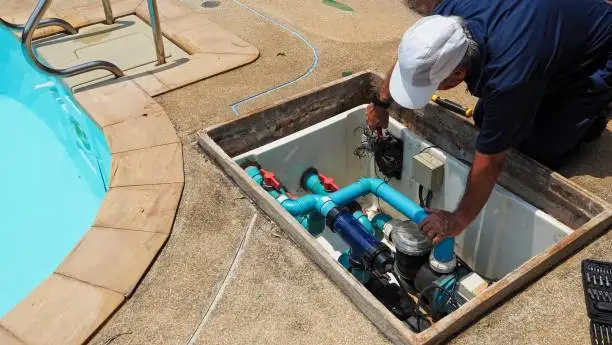
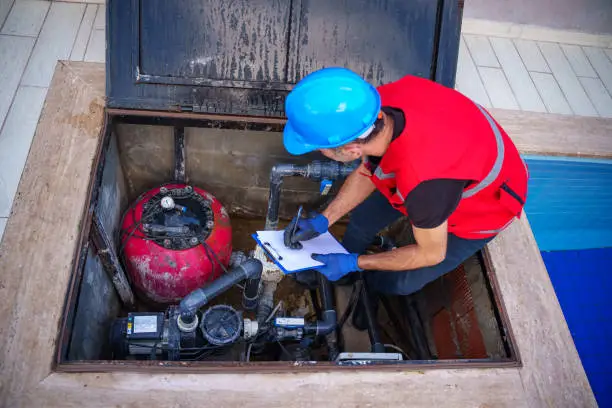
Pump and plumbing access at an equipment enclosure.Inspection includes the pump, filter and connected fittings.
Single speed and variable speed: what the controls do
A fixed-speed pump runs at one motor speed. A compatible variable-frequency drive or an integrated variable-speed motor can adjust it across a speed range; it is not limited to two settings. Pentair’s 5 HP WhisperFloXF VS, for example, has four programmable settings within a 300–3,450 RPM range. The operating speed must still provide the circulation needed by the pool and connected treatment equipment.
Common commercial pump failures we investigate
Leaking seals and suction-side air leaks
A mechanical shaft seal can leak between the motor and pump. Damaged lid O-rings, loose connections or suction-side leaks can admit air and cause loss of prime. The inspection checks where the leak starts before choosing parts.
Bearing noise, blocked impellers and poor flow
Worn bearings may make the motor noisy, while debris in the basket or impeller can reduce flow. A noisy system may also have a circulation problem such as cavitation. We assess the pump alongside the plumbing and filter.
Overheating, electrical faults and drive problems
Poor ventilation, incorrect supply voltage or a failing motor can cause overheating or shutdowns. Three-phase systems and electronic drives need model-specific checks. Repeatedly resetting a fault does not identify its cause; diagnosis should come first.
Seal and component repairs before a full equipment change
Gaskets, O-rings and shaft seals
A flattened lid O-ring can let air into the system. A worn mechanical shaft seal may leak between the pump and motor. A suitable seal or fitting repair can cost far less than replacing serviceable equipment, but the cause and parts availability need checking first.
Motor and flow problems
A blocked basket, clogged impeller, suction leak or worn motor can all reduce performance. Some motors have replaceable capacitors; modern electronic drives have different faults. Diagnosis should identify the actual component rather than assume every hum means a whole new pump.
A cracked filter is a separate issue
The filter tank is not the pump. A leaking filter O-ring may be a parts repair, but a cracked pressure-filter tank or lid needs the damaged component replaced according to the manufacturer. Do not run a cracked tank or treat a patch as a safe pressure-vessel repair.
Pool Filter Repair & Replacement
A worn O-ring, a blocked cartridge and a cracked filter tank are different problems. We assess the filter, seals, connections and pressure changes before comparing cleaning, replacement parts or a new filter. Cracked pressure-filter components must be replaced according to the manufacturer rather than patched. Replacement filtration needs to suit the pump, plumbing and operating requirements.
When pump replacement makes more sense
Compare replacement when the housing is damaged, the motor and controls both need major work, parts are unavailable or repairs keep recurring. A variable-speed model may be a sensible upgrade, but it must suit the pool, filter, heater, pipework and controls. Savings depend on the old equipment, operating schedule and settings; they are not a guaranteed dollar amount.
How long does a pool pump last in Florida?
ENERGY STAR lists an age of 7–10 years as one reason to consider replacement, alongside poor performance, excessive noise and overheating. Treat that as a planning checkpoint, not a deadline. Orlando’s long operating season, direct sun, moisture, blocked airflow and debris can add stress; a well-kept pump may remain repairable beyond that point.
Brands and the equipment around them
We install pool pump brands like Hayward, Pentair, Jacuzzi and Jandy, as well as others. Model compatibility, pipe connections, motor requirements and automation matter more than brand alone. Brand names describe equipment options and do not imply authorized-dealer or warranty-service status.
Commercial pump work starts with the approved circulation needs
For hotel, apartment and community pools, repairs are planned with the responsible operator and the existing circulation and disinfection requirements. Changing capacity, controls or other equipment may require county health department or building review, depending on the work. We do not apply a residential energy-saving schedule to a public pool without checking its operating needs.
What changes the repair or replacement price?
Pool pump replacement typically ranges from $1,900 to $5,000. Miscellaneous repairs, including suitable gasket, seal and small fitting work, typically range from $150 to $500. The failed part, equipment model, access and any plumbing or electrical changes determine the written scope. Commercial systems and larger filter replacements are assessed separately.
Commercial Pool Pump Repair FAQs
Can a leaky gasket save me from buying a new pump?
Yes, if the gasket is the actual fault and the rest of the pump is sound. A targeted repair can avoid hundreds or potentially thousands in replacement expense, depending on the equipment and the written quotes.
Can a cracked filter tank be patched?
A cracked pressure-filter tank or lid needs the damaged component replaced in line with its manual. A small seal leak is a different problem.
Should I buy the biggest pump?
No. Oversizing can create poor equipment matches and unnecessary cost. Required circulation, filter limits and the full system determine the choice.
Why does the pump shut down on hot days?
Possible causes include poor airflow, blocked cooling passages, electrical faults or a failing motor or drive. Keep the area accessible and have the cause assessed rather than repeatedly resetting it.